
REST vs GraphQL vs gRPC: Choosing the Right API Architecture for Your Product
Compare REST, GraphQL, and gRPC API architectures — learn which suits your product's performance, scalability, and team needs. A practical guide for business leaders.
BACKEND DEVELOPMENTCUSTOM SOFTWARE DEVELOPMENTAPI
Srushti M.
6/25/20268 min read
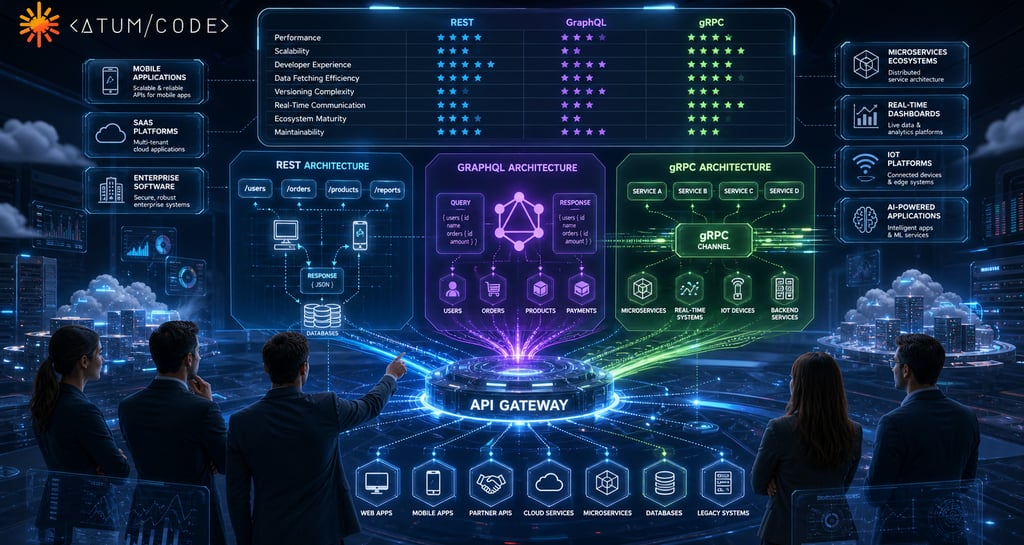
Introduction: The Decision That Quietly Shapes Everything
Most product decisions happen in meeting rooms with whiteboards and loud opinions. API architecture decisions happen in pull requests and design documents — quietly, early, and with long-lasting consequences.
The API layer is the backbone of every modern digital product. It controls how your mobile app talks to your backend, how your services share data with each other, and how your platform integrates with third-party tools. Get this decision right and your product scales gracefully. Get it wrong and you spend the next two years fighting performance bottlenecks, versioning headaches, and frustrated developers.
Three architectures dominate the modern landscape: REST, GraphQL, and gRPC. Each has genuine strengths. Each has real trade-offs. And none is universally "the best."
This guide breaks down what each approach actually means for your product — in plain language, with practical business context. By the end, you'll know which architecture fits your situation and why.
What Are We Actually Comparing?
Before diving into trade-offs, a quick orientation on what each approach is.
REST (Representational State Transfer) is the oldest and most widely adopted API style. It uses standard HTTP methods — GET, POST, PUT, DELETE — and structures data around resources (like /users, /orders, /products). If you've ever integrated a third-party API, there's a strong chance it was RESTful.
GraphQL is a query language for APIs developed by Facebook in 2012 and open-sourced in 2015. Rather than calling fixed endpoints, clients send queries describing exactly the data they need. The server returns precisely that — nothing more, nothing less.
gRPC (Google Remote Procedure Call) is a high-performance framework built on HTTP/2 and Protocol Buffers (Protobuf). Instead of thinking in terms of resources or queries, gRPC lets services call functions on remote servers as if they were local. It's fast, type-safe, and built for inter-service communication at scale.
REST: The Proven Workhorse
Why It Still Dominates
REST has been the default API architecture for over two decades for good reason. The ecosystem is enormous. Documentation is widely understood. Every developer you hire already knows it. Every framework you consider already supports it.
For public APIs, third-party integrations, and straightforward CRUD applications, REST remains the most practical choice. The tooling is mature, debugging is simple (HTTP is human-readable), and onboarding new team members is fast.
Where REST Falls Short
REST runs into predictable problems as products grow more complex:
Over-fetching: An endpoint returns a full user object when you only needed the user's name and email. Every field you don't need is bandwidth wasted.
Under-fetching: You need data from three resources, so you make three separate API calls. On a mobile connection, that adds up fast.
Versioning complexity: When your API evolves, you either break existing clients or maintain parallel versions (/v1/, /v2/). Neither option is clean.
Rigid structure: The client gets what the server decided to return — not what the client actually needs.
When to Choose REST
REST is the right call when:
You're building a public API consumed by third parties
Your team is small or you're early-stage with limited engineering bandwidth
Your product has straightforward, resource-based data needs
You're integrating with existing systems that expect HTTP/REST patterns
GraphQL: Precision Data Fetching at the Cost of Complexity
What Makes It Powerful
GraphQL was born out of Facebook's need to power a mobile news feed with wildly varying data requirements across different screens and devices. The insight was simple but transformative: let the client define the shape of the response.
With GraphQL, a single endpoint handles all queries. Clients ask for exactly what they need, receive exactly that, and network payloads shrink considerably. This is especially powerful for mobile applications where data efficiency directly affects user experience and battery consumption.
GraphQL also introduces a strongly typed schema — a contract between frontend and backend teams. This schema becomes living documentation, and it enables powerful developer tooling like auto-complete, query validation, and real-time introspection.
The Real Trade-offs
GraphQL's flexibility doesn't come free:
Caching is harder. REST's URL-based caching is elegantly simple. GraphQL sends everything to one endpoint via POST requests, which standard HTTP caches don't handle well. You'll need specialized solutions.
Query complexity can bite you. Without careful controls, clients can write deeply nested queries that hammer your database. Rate limiting and query depth analysis require intentional engineering effort.
Operational overhead. Setting up a GraphQL server, managing the schema, and tooling for monitoring adds real complexity — especially for teams new to the paradigm.
Learning curve. Junior developers and backend engineers coming from REST backgrounds need time to get productive.
When to Choose GraphQL
GraphQL shines when:
You're building mobile-first products where data efficiency matters
Your frontend teams work across multiple platforms (web, iOS, Android) with different data needs
Your product has complex, interconnected data relationships
Developer experience and productivity is a strategic priority
You're building an API that powers a rich, interactive UI (dashboards, social feeds, configurable reports)
gRPC: The High-Performance Backend Workhorse
Built for Speed at Scale
gRPC isn't designed for browser-to-server communication — it's designed for server-to-server communication at high volume and low latency. Think microservices architectures, real-time streaming systems, and internal platform services processing millions of requests.
The performance advantages are substantial. gRPC uses HTTP/2 (which supports multiplexing, allowing multiple requests over a single connection), and Protobuf serialization (which produces smaller payloads than JSON — often 5-10x smaller). The result is noticeably faster communication, especially at scale.
gRPC also supports bidirectional streaming — both client and server can push data to each other simultaneously — which opens up real-time use cases that REST handles awkwardly at best.
The Limitations to Know
gRPC is powerful but narrow:
Browser support is limited. Standard gRPC doesn't work directly in web browsers without a proxy layer (gRPC-Web). It's primarily a backend technology.
Debugging is harder. Protobuf is a binary format — you can't just read it in your browser's network tab the way you can with JSON.
Smaller ecosystem. The tooling and community resources are excellent but still smaller than REST's decades-deep ecosystem.
Steeper learning curve. Protobuf schema design and gRPC service definitions add complexity most REST developers aren't immediately comfortable with.
When to Choose gRPC
gRPC is the right architecture when:
You're building a microservices platform with heavy inter-service communication
You need real-time or streaming data (IoT, financial data feeds, live collaboration tools)
Performance and payload efficiency are critical requirements
Your engineering team is comfortable with backend complexity
You're operating at a scale where milliseconds and bandwidth costs genuinely matter
The Hybrid Architecture Reality
Here's a truth most "REST vs GraphQL vs gRPC" articles skip: most serious products use more than one.
A common, pragmatic pattern for a growing SaaS product looks like this:
REST for public APIs and third-party integrations, where simplicity and broad compatibility matter
GraphQL for the client-facing layer powering web and mobile apps, where data efficiency and DX matter
gRPC for internal microservice communication, where performance and type safety matter
Choosing an API architecture isn't always an either-or decision. It's about matching the right tool to the right context within your architecture.
Expert Insights from AtumCode
After working across dozens of product builds — from early-stage startups to enterprise platforms — our engineering team at AtumCode has developed some clear perspectives on how these decisions play out in practice.
Start with REST, but design for evolution. Most products don't need GraphQL or gRPC from day one. The complexity they introduce isn't justified until you have specific, real pain points: slow mobile load times, multiple frontends with divergent data needs, or high-frequency inter-service traffic. Starting with well-structured REST and clean separation of concerns gives you room to layer in GraphQL or gRPC later without a full rewrite.
Don't choose GraphQL to solve a team coordination problem. One of GraphQL's most appealing promises is that frontend teams can query what they need without waiting for backend changes. That's real. But we've seen teams adopt GraphQL to paper over poor internal communication — and they end up with a flexible API and the same coordination problems. GraphQL is a technical tool, not a process fix.
gRPC investment pays off at the right scale. If your architecture roadmap includes microservices and you're processing significant request volume, investing in gRPC early pays dividends. The performance characteristics at scale are genuinely impressive. But don't introduce it because it's interesting — introduce it because the problem demands it.
The schema-first mindset is the real win. Both GraphQL and gRPC push you toward explicit schema definitions and strong contracts between services. Even if you stay with REST, adopting OpenAPI/Swagger specifications gives you similar benefits: auto-generated documentation, type safety, and clear API contracts. The discipline matters more than the technology.
Evaluate your team's existing competency. The best architecture your team can't operate confidently is worse than the second-best architecture they own completely. Factor in onboarding time, available tooling knowledge, and the realistic learning curve before making the call.
What to Expect in the Coming Years
The API landscape is shifting in several meaningful directions that will affect decisions made today.
GraphQL adoption will continue rising in the frontend-heavy product space. As more products invest in rich, data-intensive user interfaces — dashboards, collaboration tools, AI-powered interfaces — GraphQL's precise data fetching becomes increasingly compelling. The tooling ecosystem, particularly around caching (Apollo, Relay), has matured significantly and continues to improve.
gRPC's role will expand with microservices proliferation. As more organizations move toward microservices and service mesh architectures, gRPC's performance and strong typing will become standard in backend infrastructure. Envoy, Istio, and similar service meshes have first-class gRPC support, which lowers the operational barrier.
AI-native products are creating new API design patterns. The rise of AI agents, LLM-powered features, and multi-step automated workflows is already pushing API design toward more streaming-friendly, event-driven patterns. gRPC's streaming capabilities and GraphQL subscriptions are well-suited to these workloads. REST, in its traditional request-response form, fits awkwardly.
API gateways and federation layers are becoming essential. As organizations adopt multiple API patterns across different services, the gateway layer that unifies them becomes critical. Tools like Apollo Federation (for GraphQL), Kong, and AWS API Gateway are seeing significant investment. Expect the "unified API plane" to become the default architecture pattern for anything beyond a single monolith.
GraphQL and REST continue to converge. REST APIs increasingly adopt OpenAPI specifications for type safety. GraphQL tooling increasingly supports caching patterns closer to REST. The strict boundaries between them are softening — what matters more is API discipline than the specific technology.
Conclusion: The Right Answer Depends on Your Context
There's no universally correct API architecture. There's only the right architecture for your product's specific requirements, your team's capabilities, and your current stage of growth.
Here's the practical summary:
Choose REST when you need simplicity, broad compatibility, and developer familiarity — especially for public APIs and early-stage products.
Choose GraphQL when mobile performance, developer experience, and complex data relationships are high-priority concerns.
Choose gRPC when internal performance, streaming, and microservice communication at scale are the defining requirements.
Combine them when different parts of your product have genuinely different requirements — which is more common than most architecture discussions acknowledge.
The most expensive API decision isn't picking the "wrong" architecture. It's picking an architecture without clearly understanding your requirements, your team's capabilities, and your product's direction — and then locking yourself into patterns that fight your growth rather than support it.
Take the time to get this right at the start. It will save you significant rework down the line.
Need Help Choosing the Right API Strategy for Your Product?
Whether you're planning a new product, modernizing an existing backend, or evaluating technical proposals from a development partner, the API architecture decision deserves careful, experienced input — not just a quick Google search.
At AtumCode Solutions, our engineering teams have designed and built API layers across mobile apps, SaaS platforms, enterprise systems, and AI-powered products. We understand not just what each architecture does, but when it genuinely makes sense for your business context and growth stage.
Contact our team for a free consultation and discover the most effective technical path forward for your product.
AtumCode Solutions specializes in Mobile App Development, Web Development, Custom Software Development, UI/UX Design, Product Development, AI Solutions, Cloud Solutions, and Digital Transformation. We work with startups, growing businesses, and enterprise teams to build scalable digital products that perform.
Connect With Us
Your partner in custom software solutions and design.
Innovate Today, Reach Out!
contact@atumcode.com
+1 202 292 4041
+91 801 091 1708
© 2026. All rights reserved.
Warje, Pune 411058, Maharashtra, India

AtumCode Solutions Pvt. Ltd.
Beyond Code, Building Vision!
D&B D-U-N-S Number : 76-637-9675