
The Next Frontier: Combining Blockchain and AI in Secure, Intelligent Apps
The convergence of blockchain and AI is redefining what secure, intelligent applications can achieve. While AI powers smart decision-making, predictive analytics, and automation, blockchain ensures transparency, security, and trust through decentralized data management. Together, they unlock powerful use cases—from fraud-resistant fintech apps and secure healthcare systems to intelligent supply chains and decentralized marketplaces. This blog explores how integrating blockchain with AI creates smarter, tamper-proof digital ecosystems and highlights how AtumCode leverages emerging technologies to build future-ready, secure, and innovation-driven applications.
AIBLOCKCHAINCUSTOM SOFTWARE DEVELOPMENTBACKEND DEVELOPMENT
Srushti M.
3/3/20268 min read
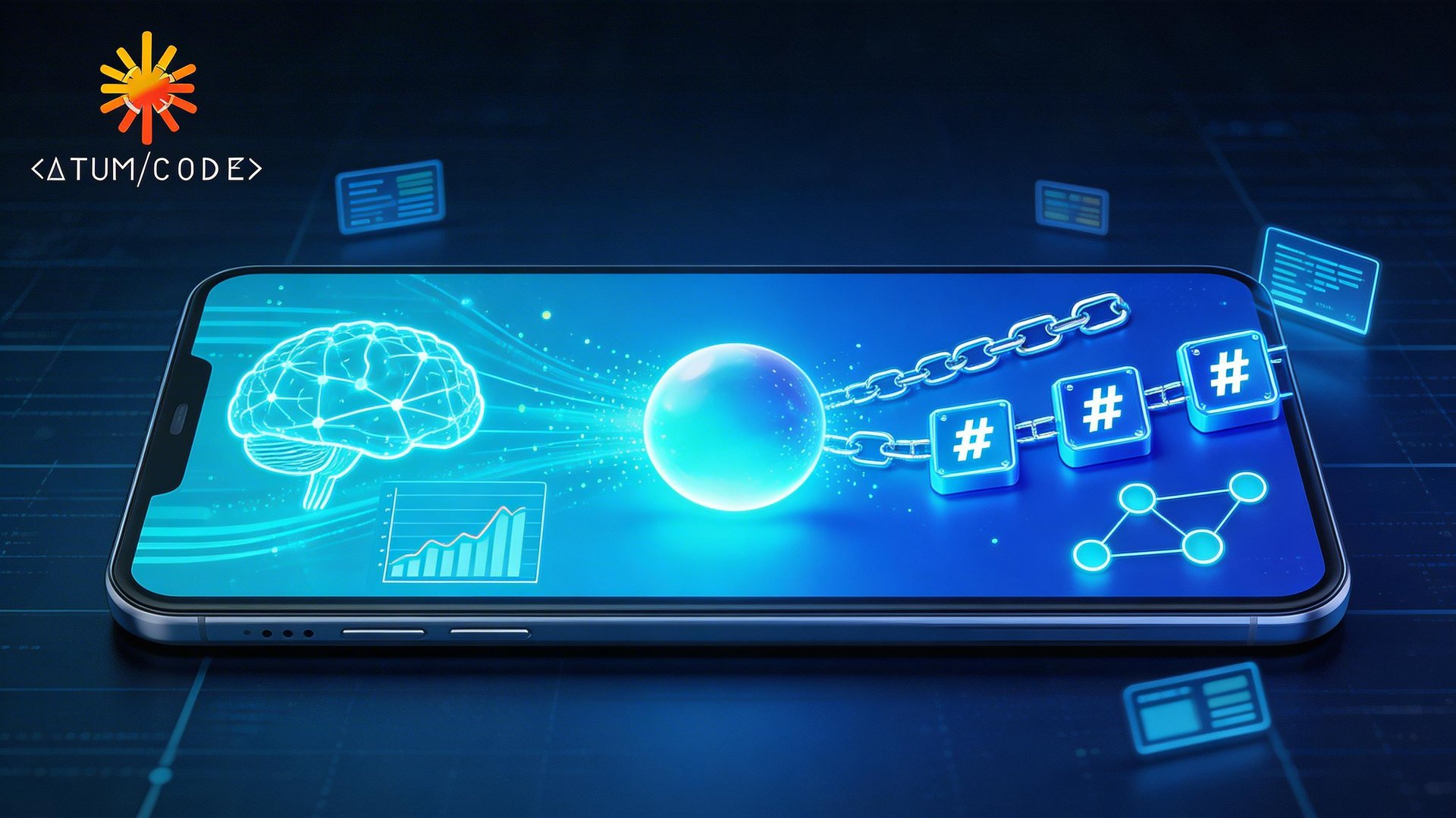

Introduction to Blockchain and AI
In recent years, two technologies have risen to prominence due to their transformative potential: blockchain and artificial intelligence (AI). Blockchain is a decentralized ledger technology that enables the secure and transparent recording of transactions across a network. Its primary functions include eliminating intermediaries, enhancing security through cryptography, and ensuring data integrity. By providing a transparent record of activity, blockchain has gained traction in various sectors, including finance, supply chain management, and healthcare.
On the other hand, artificial intelligence encompasses a range of technologies that allow machines to perform tasks that typically require human intelligence. This includes learning, reasoning, problem-solving, perception, and language understanding. Recent advancements in machine learning and natural language processing have significantly improved AI capabilities, leading to its increasingly prevalent application across industries. From predictive analytics to personalized user experiences, AI is shaping the future of application development.
The convergence of blockchain and AI marks a pivotal moment in the evolution of technology. Both fields have experienced substantial advancements, with blockchain providing a robust framework for securing data generated by AI systems. Meanwhile, AI can be utilized to enhance the efficiency of blockchain networks through predictive algorithms and smart contract automation. This combination is anticipated to revolutionize app development, creating secure and intelligent applications capable of making autonomous decisions based on real-time data processing.
As these two technologies continue to advance, their integration will pave the way for innovative applications, addressing key challenges in security, data reliability, and operational efficiency. The potential to create applications that are not only secure but also intelligent underscores the significance of understanding both blockchain and AI in today’s technological landscape.
The Synergy Between Blockchain and AI
The symbiotic relationship between blockchain technology and artificial intelligence (AI) presents unique opportunities for the development of secure and intelligent applications. Each of these technologies possesses inherent strengths that, when combined, enhance their overall effectiveness. Blockchain is characterized by its transparency, security, and decentralization, while AI excels in data processing, learning, and analytical capabilities. Together, they create a powerful toolkit for addressing modern challenges in technology.
Blockchain's main advantage lies in its decentralized nature, which allows for data to be stored securely across a network of computers. This decentralization mitigates the risks associated with data breaches and fraud, enabling trust among users without the need for a central authority. Furthermore, the transparency offered by blockchain technology ensures that all transactions and data inputs are recorded in an immutable ledger, making it easier to verify their authenticity, an aspect crucial for sensitive applications such as finance or healthcare.
On the other hand, AI brings the ability to analyze vast amounts of data, drawing insights that can significantly enhance decision-making processes. By training on data sourced from blockchain, AI algorithms can improve their learning capabilities, ensuring better predictive analytics and automated processes. For instance, machine learning algorithms can recognize patterns in transaction data registered on a blockchain, enabling enhanced fraud detection mechanisms that operate in real-time.
By leveraging the strengths of both blockchain and AI, developers can create applications that are not only efficient but also secure. This collaboration facilitates the design of systems that can maintain integrity while supporting advanced functionalities. Such applications may be vital in industries such as supply chain management, healthcare, and finance, where security and reliability are paramount. In essence, the integration of these two technologies heralds a new era of intelligent applications that are both secure and efficient.
Use Cases in Various Industries
The combination of blockchain and artificial intelligence (AI) is leading to transformative results across multiple industries. In finance, for instance, institutions are utilizing AI algorithms to analyze blockchain data, improving fraud detection and risk management. With AI's predictive analytics capabilities, financial organizations can better assess potential risks associated with transactions recorded on a blockchain, thus enhancing security and trust.
In the healthcare sector, integrating blockchain with AI enables secure sharing and management of patient data. Applications are emerging that use AI to analyze large datasets from multiple healthcare providers while ensuring data integrity through blockchain technology. This combination not only improves patient outcomes by providing healthcare professionals with comprehensive insights but also ensures compliance with regulations related to data privacy.
The supply chain industry also showcases significant advancements via the blockchain and AI partnership. Companies are utilizing blockchain for transparent and tamper-proof tracking of goods throughout the supply chain. AI enhances this process by forecasting demand and supply fluctuations, optimizing inventory management, and thereby reducing costs. For example, the use of AI-powered analytics alongside blockchain allows for real-time decision-making, enhancing efficiency and reducing waste.
Furthermore, in the realm of smart contracts, AI can assess the conditions of contracts recorded on a blockchain automatically. This almost autonomous capability opens new avenues for contract execution and enforcement, evidenced by numerous startups now offering AI-driven contract management solutions. In this manner, both blockchain and AI work synergistically, improving operational efficiencies across different sectors.
Overall, these examples illustrate how industries are leveraging the dual capabilities of blockchain and AI to drive transparency, enhance decision-making, and achieve greater operational efficiencies. The innovation potential held by these technologies hints at a transformative future economy, with organizations keen to explore their myriad applications.
Ensuring Data Security and Privacy
The integration of blockchain and artificial intelligence (AI) significantly enhances data security and user privacy in various applications. One of the core features of blockchain technology is its decentralized nature, which mitigates the risks associated with a centralized data repository. Unlike traditional systems, where a single point of failure can jeopardize the entire system, blockchain distributes data across a network of nodes, making it more resilient to attacks and unauthorized access.
Smart contracts play a pivotal role in this landscape by automating and enforcing agreements between parties without the need for intermediaries. These self-executing contracts are built on the blockchain and can incorporate specific conditions that must be met for transactions to occur. This not only streamlines processes but also enhances trust, as all stakeholders can verify actions through immutable records. Furthermore, smart contracts can be engineered to ensure compliance with regulations such as the General Data Protection Regulation (GDPR), which mandates strict guidelines for data protection.
Encryption is another critical component in safeguarding user information. By utilizing advanced cryptographic techniques, data stored on the blockchain can be secured from unauthorized access. This ensures that sensitive information remains confidential, even when it is shared across a distributed network. AI can further bolster this security by enabling dynamic risk assessment and anomaly detection, identifying potential threats before they escalate.
The decentralized storage of data not only enhances security but also provides users with greater control over their personal information. Unlike traditional databases where users have limited visibility and control, blockchain empowers individuals to manage their data actively. This shift not only supports user autonomy but also fosters a culture of transparency and accountability in data handling processes. The synergy between blockchain and AI thus not only fortifies data security frameworks but also cultivates user trust and compliance with evolving global regulations.
Challenges and Limitations
Integrating blockchain technology with artificial intelligence (AI) presents several notable challenges and limitations that can hinder the development of secure and intelligent applications. One of the primary obstacles is technological limitations; both fields are still relatively nascent, with many platforms and protocols undergoing continuous evolution. As a result, standardization is often lacking, which complicates the integration process between AI systems and blockchain networks.
A significant challenge arises in terms of scalability. Blockchain networks, particularly those that utilize proof-of-work mechanisms, can experience performance bottlenecks when processing large volumes of data. This limitation can hinder the ability of AI algorithms to receive real-time data necessary for timely decision-making, which is critical for effective AI functionality. On the other hand, AI models often require vast datasets to train effectively; if the underlying blockchain cannot efficiently handle such volumes, the potential for fully effective integration diminishes.
Moreover, the complexity of integration should not be underestimated. Combining AI with blockchain infrastructure typically necessitates a multidisciplinary approach involving expertise in various fields, including cryptography, data science, and software development. This complexity may lead to increased development costs and timelines, potentially deterring organizations from pursuing such projects.
Data quality issues also represent a significant challenge. AI algorithms are highly dependent on large datasets; if the data fed into these systems is incomplete, biased, or inaccurate, the output will similarly be flawed. Furthermore, there is a growing concern regarding bias within AI algorithms, which can lead to unfair or unethical outcomes. Proper governance in blockchain networks is therefore crucial, as it ensures the accuracy and integrity of the data used for training AI models. Establishing robust governance frameworks can help mitigate these issues and promote trust in the integrated systems.
Future Trends and Innovations
The integration of blockchain and artificial intelligence (AI) represents a revolutionary approach to application development, poised to redefine various sectors. With rapid advancements in both technologies, we can anticipate emerging trends that will shape the future landscape of secure, intelligent applications. One of the most significant innovations expected is enhanced data security through decentralized AI models built on blockchain platforms. This development would allow AI algorithms to leverage data from numerous sources without compromising privacy or security, thus fostering trustworthy applications.
Atumcode is at the forefront of such innovations, actively exploring how these two technologies can complement each other. Through projects that focus on creating decentralized AI applications, Atumcode aims to set new standards for operational transparency and user empowerment. One of its pioneering initiatives involves integrating AI-driven analytics with smart contract functionalities on the blockchain. This approach not only improves decision-making processes but also streamlines operations by reducing reliance on centralized entities.
Another area of potential advancement lies in the area of predictive analytics within the blockchain ecosystem. As machine learning models become increasingly sophisticated, they can analyze vast amounts of blockchain data to predict trends, anomalies, and potential security threats. This predictive capability could significantly enhance risk management for businesses, enabling proactive measures against possible breaches or inefficiencies.
Furthermore, we may witness the emergence of "trustless" AI systems that operate independently of centralized control, thereby increasing their reliability and reducing the risk of manipulation. This paradigm shift has profound implications for industries ranging from finance to healthcare, where data integrity and security are paramount. In the coming years, as these technologies converge, the opportunities for creating intelligent, secure applications will expand, paving the way for unprecedented innovations.
Conclusion: Embracing the Future of Intelligent Apps
As the landscape of technology evolves, the convergence of blockchain and artificial intelligence (AI) presents a transformative opportunity for developing advanced, secure applications. Throughout this discussion, we have explored the myriad ways in which these two groundbreaking technologies can work cohesively to enhance application security, streamline processes, and elevate user experiences. The integration of blockchain’s decentralized architecture with AI's data processing capabilities enables the creation of applications that not only protect user information but also offer intelligent decision-making capabilities.
One notable benefit of this combination lies in enhanced security protocols. Blockchain's immutable ledger provides a strong foundation for safeguarding data against unauthorized access, a vital consideration in today’s digital environment where privacy is paramount. At the same time, AI algorithms can effectively analyze and predict potential security threats, ensuring that intelligent applications remain resilient against emerging cyber vulnerabilities.
Furthermore, harnessing AI alongside blockchain allows for the development of applications that exhibit adaptive learning capabilities. As these applications gather user data, they can refine their operations and improve service delivery, ultimately leading to a more effective interaction between users and technology. This dynamic growth contributes to a more intuitive user experience, catering directly to specific needs and preferences.
In embracing the integration of blockchain with AI, developers and organizations position themselves to meet the demands of a rapidly changing technological landscape. This fusion not only fosters greater efficiency and reliability in applications but also underscores the immense potential of leveraging these technologies for innovative solutions. As we look ahead, it is imperative that stakeholders recognize and act on the possibilities presented by this powerful combination, paving the way for a future of intelligent applications that are secure, responsive, and user-centric.
Connect With Us
Your partner in custom software solutions and design.
Innovate Today, Reach Out!
contact@atumcode.com
+1 202 292 4041
+91 801 091 1708
© 2026. All rights reserved.
Warje, Pune 411058, Maharashtra, India

AtumCode Solutions Pvt. Ltd.
Beyond Code, Building Vision!
D&B D-U-N-S Number : 76-637-9675