
How AI Agents Are Replacing Traditional Business Software in 2026
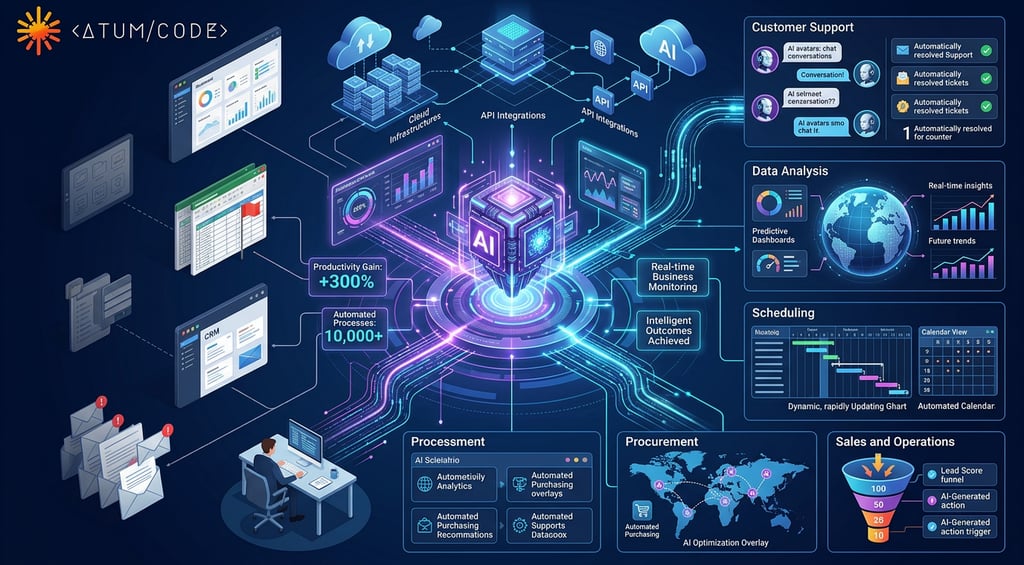
AI agents are rapidly transforming how businesses operate in 2026, replacing many traditional software tools with intelligent, autonomous systems that can think, decide, and act independently. From customer support and data analysis to scheduling and procurement, AI agents are streamlining operations, reducing costs, and improving efficiency at scale. This blog explores how AI agents differ from conventional chatbots, the business functions they are disrupting, and why companies that invest in custom AI solutions today are gaining a significant competitive advantage over those still relying on legacy software.
AICUSTOM SOFTWARE DEVELOPMENTMOBILE APP DEVELOPMENTWEB DEVELOPMENT
Akshay T.
6/9/20267 min read
Introduction to AI Agents and Their Impact on Business
The rise of AI agents marks a significant milestone in the evolution of business software, fundamentally transforming how organizations operate. An AI agent is a computer program capable of autonomously executing tasks that typically required human intervention. This shift towards automation has accelerated dramatically, particularly in the past few years, setting the stage for a pivotal change in 2026.
Traditionally, business software relied heavily on manual inputs, where users interacted with systems to perform specific tasks such as data entry, report generation, and customer management. The introduction of AI agents has revolutionized this model, enabling businesses to increase efficiency and reduce the potential for human error. By leveraging advanced algorithms and machine learning, these agents can analyze vast amounts of data, predict outcomes, and make decisions—functions that were once solely within the human domain.
The advancements in AI technology have been remarkable, propelling the adoption of AI agents across various sectors. From automating routine administrative functions to enhancing customer service with intelligent virtual assistants, the impact of AI agents is being felt in every aspect of a business. Their capability to integrate seamlessly with existing systems creates a hybrid environment where traditional software and cutting-edge AI can work in tandem, thereby optimizing operational workflows.
As we progress into 2026, the significance of AI agents within the business sphere will only amplify. Organizations that embrace this technology can expect to see improvements in productivity, cost-effectiveness, and decision-making processes. The relevance of this transition cannot be overstated, as it represents not just an evolution in technology, but a fundamental change in how business is conducted in the modern era.
Understanding Autonomous AI Agents vs. Traditional Tools
As businesses increasingly transition to digital frameworks, the distinction between autonomous AI agents and traditional business software is becoming more pronounced. Autonomous AI agents represent a significant evolution in technology, designed to perform tasks with minimal to no human intervention, a feature that sets them apart from conventional tools, such as basic chatbots or software applications.
Traditional business software typically requires explicit instructions from users and is limited by pre-defined parameters. For instance, simple chatbots can respond to frequently asked questions but lack the capacity to understand context or learn from interactions. These tools tend to follow a rigid set of rules, leading to inefficiencies and missed opportunities for automation in complex business processes.
In contrast, autonomous AI agents leverage advanced algorithms and machine learning to adapt and evolve over time. They can learn from data, recognize patterns, and make decisions independently, which allows them to handle multifaceted tasks that would be cumbersome or impossible for traditional software. For example, an AI agent can manage customer relations by automatically analyzing customer feedback, adjusting marketing strategies in real-time, and personalizing communication based on individual preferences. This capability signifies a shift towards software that can intuitively navigate complex scenarios, improving operational efficiency.
Further illustrating this difference, consider the task of project management. Traditional project management software may require users to update progress manually and generate reports, whereas an autonomous AI agent can track progress, analyze performance metrics, and even predict potential project delays through continuous data assessment.
In summary, the transition from traditional tools to AI agents signifies a profound shift in how businesses operate, enabling them to become more agile, responsive, and efficient in today’s fast-paced environments.
Customer Support Transformation
AI agents have significantly altered the landscape of customer support. Traditionally reliant on human representatives who manage inquiries and provide assistance, businesses are now integrating AI-driven systems to enhance responsiveness and efficiency. AI agents can operate 24/7, responding to customer inquiries in real-time through chatbots and virtual assistants. This development reduces wait times and ensures that clients receive support, regardless of timing, thus improving overall customer satisfaction.
Data Analysis Evolution
The use of AI agents in data analysis has revolutionized how organizations interpret vast datasets. With artificial intelligence, businesses can swiftly process and analyze information, identifying trends and patterns that manual methods may overlook. Insights generated by AI can lead to more informed decision-making, enhancing the company’s strategic planning. By automating data analysis, organizations experience increased accuracy, reduced human error, and the ability to focus more on insights rather than data collection.
Scheduling Automation
Scheduling tasks that once required significant human effort are now efficiently managed by AI agents. Businesses utilize these intelligent systems to streamline meeting arrangements, resource allocations, and team schedules. By doing so, organizations experience a reduction in scheduling conflicts and improved productivity, as AI agents can quickly coordinate multiple calendars and suggest optimal meeting times based on participants’ availability. This not only saves time but also enhances collaborative efforts across departments.
Procurement Enhancement
The procurement process is another area benefiting from the integration of AI agents. These technologies facilitate better supplier selection, purchase order management, and inventory tracking. AI can analyze supplier performance, enabling businesses to make more strategic sourcing decisions. Additionally, automated procurement processes lead to reduced lead times and lower costs, allowing companies to maintain competitive pricing while ensuring the availability of necessary resources.
The Technology Behind AI Agents
Artificial Intelligence (AI) agents are transforming the landscape of traditional business software through advanced technologies such as machine learning and natural language processing (NLP). Machine learning, a subset of AI, empowers these agents to learn from data inputs, identify patterns, and improve their performance over time. This is achieved through various algorithms that process historical data, enabling AI agents to make predictions or decisions independently without explicit programming.
Natural language processing plays a crucial role in interacting with users, interpreting their commands, and providing coherent responses. By utilizing NLP, AI agents can understand context, recognize sentiment, and manage conversational interfaces, making them intuitive tools for businesses. Through frameworks like Google's BERT or OpenAI's GPT models, the agents can engage in dialogue, answer queries, and even assist in complex analytical tasks.
To successfully deploy AI agents, businesses must meet specific infrastructure and data requirements. A robust data pipeline is essential; organizations need to accumulate vast amounts of relevant data that the AI agents will learn from. This involves not only ensuring data quality but also data governance to maintain the accuracy and relevance of the information utilized for training. Furthermore, effective data storage solutions and cloud computing capabilities are paramount, as they provide the necessary computational power. Cloud platforms facilitate scalability by accommodating fluctuating demands and storage needs.
Moreover, integrating AI agents into existing systems may require a shift in organizational infrastructure. Companies must analyze their current technological ecosystem, identify integration points, and allocate resources to ensure a smooth transition from traditional business software to intelligent AI-driven solutions. This adaptability to advanced technologies ultimately heralds a redefined approach to business operations and customer engagement.
Building and Adopting AI Agents in Business
The transition to artificial intelligence (AI) agents in business operations represents a significant paradigm shift in how companies utilize technology. Organizations must approach this transformation methodically to ensure successful implementation. The first step in building and adopting AI agents is to identify suitable use cases. This involves analyzing current processes to pinpoint areas where AI agents can streamline operations, enhance productivity, or improve customer interaction. It is crucial for businesses to prioritize projects that showcase tangible benefits, which will facilitate broader acceptance within the organization.
Once relevant use cases are determined, the next step is selecting the right tools and technologies. Numerous platforms and frameworks are available that cater to different business needs. Companies should thoroughly evaluate various AI frameworks to find those that best align with their operational goals. Considerations such as scalability, compatibility with existing systems, and user-friendliness are vital during the selection process. Furthermore, collaborating with vendors that provide robust support for implementation can greatly enhance the effectiveness of these tools.
Equally important is the training of AI models to ensure their effectiveness in real-world scenarios. Proper training involves feeding the AI agents with high-quality data, which allows them to learn and adapt to business requirements. Regular updates and evaluations of these models can enhance accuracy and relevance, ultimately leading to greater operational efficiency. Employee training and involvement in this process also cannot be overlooked. By educating staff about how to interact with AI agents, businesses can foster a culture of innovation and openness to new technology.
Benefits of Partnering with AI Development Agencies
In the rapidly evolving landscape of technology, businesses are increasingly recognizing the advantages of collaborating with experienced AI development agencies. One of the significant benefits of such partnerships is the competitive edge that they provide. By enlisting the expertise of specialized AI teams, companies can access advanced knowledge and skills that may not be available in-house. This expertise ensures that businesses remain innovative and ahead of their competitors, allowing them to harness the power of AI in ways that drive growth and efficiency.
Another crucial benefit is the accelerated implementation process that AI development agencies facilitate. Developing AI solutions requires significant resources, specialized skills, and a deep understanding of the latest trends in artificial intelligence. Agencies that focus on AI development bring with them a wealth of experience in creating and deploying sophisticated AI systems, enabling businesses to implement these technologies more swiftly and effectively. This expeditious delivery can often mean the difference between capitalizing on a market opportunity and falling behind the competition.
Furthermore, partnering with AI development agencies allows businesses to leverage the latest AI technologies effectively. These agencies are continually investing in research and development, staying current with the latest advancements in machine learning, natural language processing, and other AI subfields. By collaborating with such agencies, companies ensure they are integrating cutting-edge solutions into their operations, which can lead to improved productivity, enhanced customer experiences, and more informed decision-making processes.
In summary, the collaboration between businesses and AI development agencies presents numerous advantages. From gaining a competitive edge and expediting the implementation of AI solutions to ensuring access to the latest technological innovations, these partnerships are becoming essential in the modern business environment. Organizations that successfully engage with AI development agencies are well-positioned to thrive in an increasingly automated world.
Challenges and Considerations in Integrating AI Agents
The integration of AI agents in business operations presents numerous advantages; however, challenges must be navigated to ensure successful implementation. One of the primary concerns is data privacy. AI systems often require access to sensitive data to function effectively. In industries handling confidential information, such as healthcare and finance, it is crucial to ensure that AI agents comply with data protection regulations. Organizations must adopt robust data governance frameworks to protect customer information while leveraging AI capabilities.
Scalability is another significant consideration when integrating AI agents into existing systems. Businesses must assess whether their current infrastructure can support advanced AI technologies. Often, traditional systems may not be equipped to handle the complex processing needs of AI, necessitating an investment in upgrades or new platforms. Consequently, a strategic approach to implementing AI agents can help in aligning these technologies with existing operations while ensuring that scalability challenges are addressed.
Employee training is yet another hurdle businesses face. The introduction of AI agents can transform workflows and processes, requiring employees to adapt quickly to new tools and methodologies. Organizations should invest in comprehensive training programs that not only enable staff to understand how to work alongside AI but also highlight its benefits. Fostering an environment of innovation can also help mitigate resistance from employees who may be apprehensive about changes to established practices.
Finally, potential resistance to change is a common cultural obstacle when organizations attempt to integrate AI agents. To counter this, leaders should promote a vision that emphasizes the advantages of AI, encouraging a mindset that is open to technological advancement. By addressing these challenges proactively, companies can lay a solid foundation for a successful transition to a more AI-driven operation.
Connect With Us
Your partner in custom software solutions and design.
Innovate Today, Reach Out!
contact@atumcode.com
+1 202 292 4041
+91 801 091 1708
© 2026. All rights reserved.
Warje, Pune 411058, Maharashtra, India

AtumCode Solutions Pvt. Ltd.
Beyond Code, Building Vision!
D&B D-U-N-S Number : 76-637-9675